Note
Go to the end to download the full example code.
Logical Memory#
This example demonstrates the simplest (trivial) form of computation:
logical memory. More specifically, a logical qubit with distance d
remains idle for d error correction cycles
[Acharya et.al[1]].
Construction#
A memory experiment can be represented with a single cube. The color of the cube determines the spatial/temporal boundary types.
tqec provides builtin functions in tqec.gallery.memory to
construct it.
from multiprocessing import cpu_count
from pathlib import Path

import matplotlib.pyplot as plt
import numpy
import sinter

from tqec import Basis, NoiseModel, compile_block_graph
from tqec.gallery import memory
from tqec.simulation.plotting.inset import plot_observable_as_inset
from tqec.simulation.simulation import start_simulation_using_sinter
The memory experiment preserves its logical observable through time.
correlation_surfaces = graph.find_correlation_surfaces()
graph.view_as_html(
    pop_faces_at_directions=("-Y",),
    show_correlation_surface=correlation_surfaces[0],
)
Circuit#
You can download the circuit for a d=3 logical Z memory
experiment from
here, or generate
it with the code below. You can also open the circuit in
Crumble.
Note
Note that the syndrome extraction circuits used here are of depth 7 because we use an extra layer of two-qubit gates to align with the potential spatial cubes. The depth can be reduced to 6 with some post-processing on the circuit.
compiled_graph = compile_block_graph(graph)
circuit = compiled_graph.generate_stim_circuit(
    k=1, noise_model=NoiseModel.uniform_depolarizing(p=0.001)
)
Simulation#
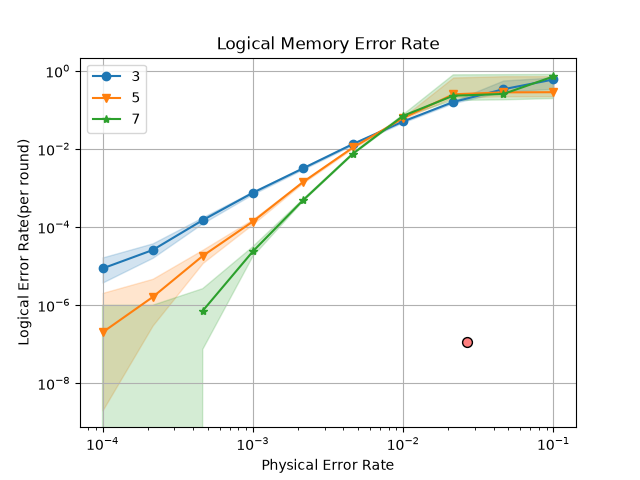
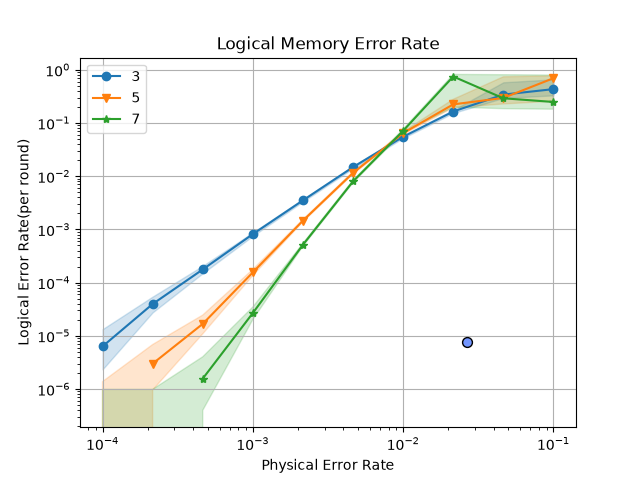
Here we show the simulation results of both Z-basis and X-basis
memory experiments under the uniform depolarizing noise model.
def generate_graphs(support_observable_basis: Basis) -> None:
    """Generate the logical error-rate graphs corresponding to the provided basis."""
    block_graph = memory(support_observable_basis)
    zx_graph = block_graph.to_zx_graph()

    surfaces = block_graph.find_correlation_surfaces()

    stats = start_simulation_using_sinter(
        block_graph,
        range(1, 4),
        list(numpy.logspace(-4, -1, 10)),
        NoiseModel.uniform_depolarizing,
        manhattan_radius=2,
        observables=surfaces,
        num_workers=cpu_count(),
        max_shots=1_000_000,
        max_errors=5_000,
        decoders=["pymatching"],
        save_resume_filepath=Path(
            f"../_examples_database/memory_stats_{support_observable_basis.value}.csv"
        ),
        database_path=Path("../_examples_database/database.pkl"),
    )

    for i, stat in enumerate(stats):
        _, ax = plt.subplots()
        sinter.plot_error_rate(
            ax=ax,
            stats=stat,
            x_func=lambda stat: stat.json_metadata["p"],
            failure_units_per_shot_func=lambda stat: stat.json_metadata["d"],
            group_func=lambda stat: stat.json_metadata["d"],
        )
        plot_observable_as_inset(ax, zx_graph, surfaces[i])
        ax.grid(axis="both")
        ax.legend()
        ax.loglog()
        ax.set_title("Logical Memory Error Rate")
        ax.set_xlabel("Physical Error Rate")
        ax.set_ylabel("Logical Error Rate(per round)")
Z Basis and X Basis Simulations
References#
Total running time of the script: (0 minutes 31.719 seconds)